ASBAR / أصبر
Al Wakrah, Qatar, 2026
A site-specific installation activated over five evenings.
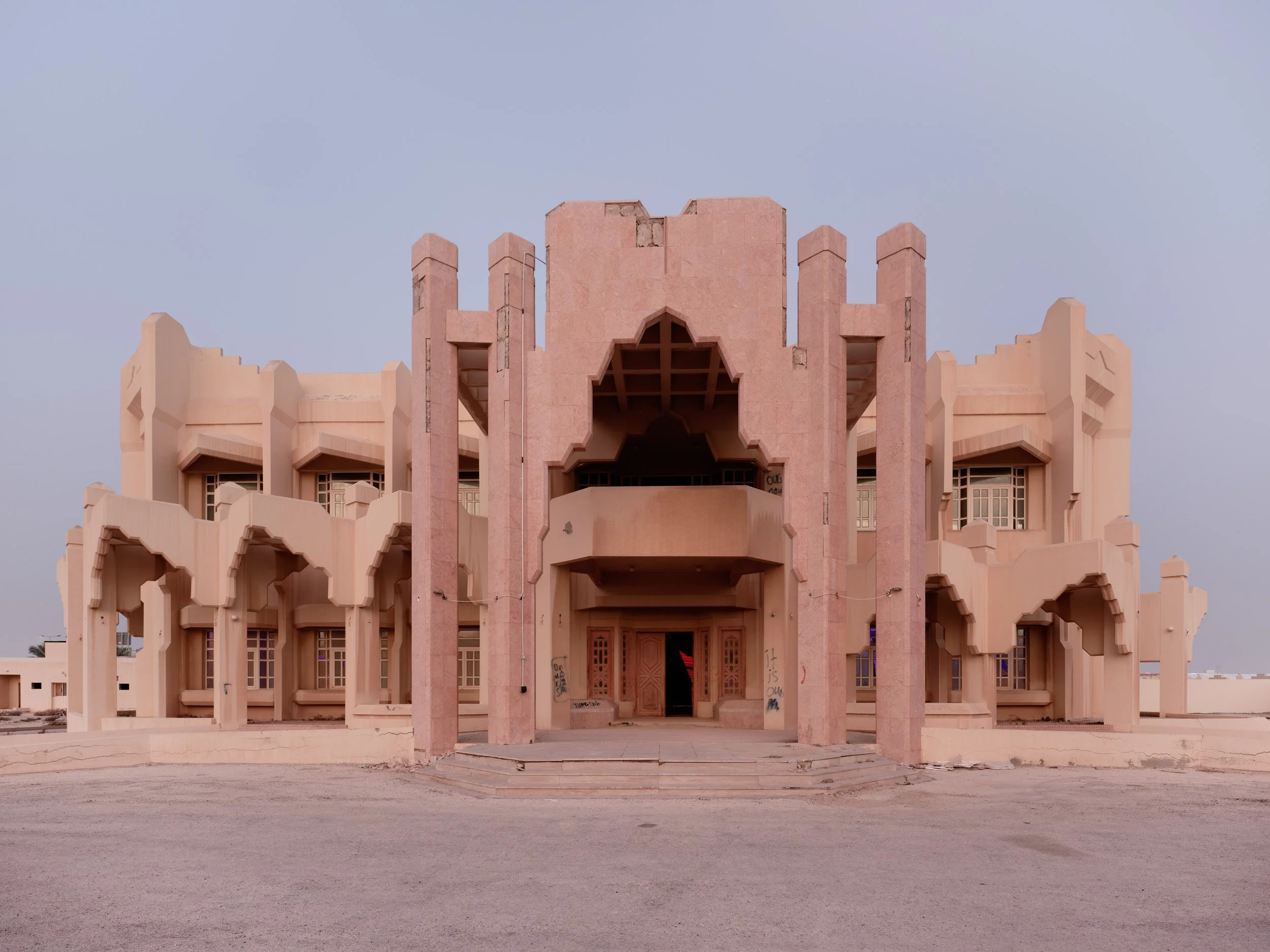
Asbar is an independently conceived, privately funded exhibition installed within an abandoned Neo-Islamic domestic structure in Al Wakrah, Qatar.
Built in the late 1980s to early 1990s, the house reflects a Gulf villa language constructed for permanence and status. Once inhabited, it now stands suspended, structurally present yet temporally unresolved.
The artist spent time within the structure prior to the exhibition, not to restore it, but to understand it and return a sense of dignity to a place left suspended. Minimal repairs were made. What remained was respected. Traces of use were left intact, and elements such as bird nests were undisturbed.
Framework
Within this setting, the exhibition constructs a psychological architecture shaped by interrupted belonging, where material, body, and environment remain held in states of suspension.
Developed outside institutional frameworks, Asbar asserts an independent model of artistic production within the Qatari context, where autonomous, site-specific practice of this scale remains rare. The artist assumes authorship not only of the works, but of the spatial and curatorial framework itself.
Material System
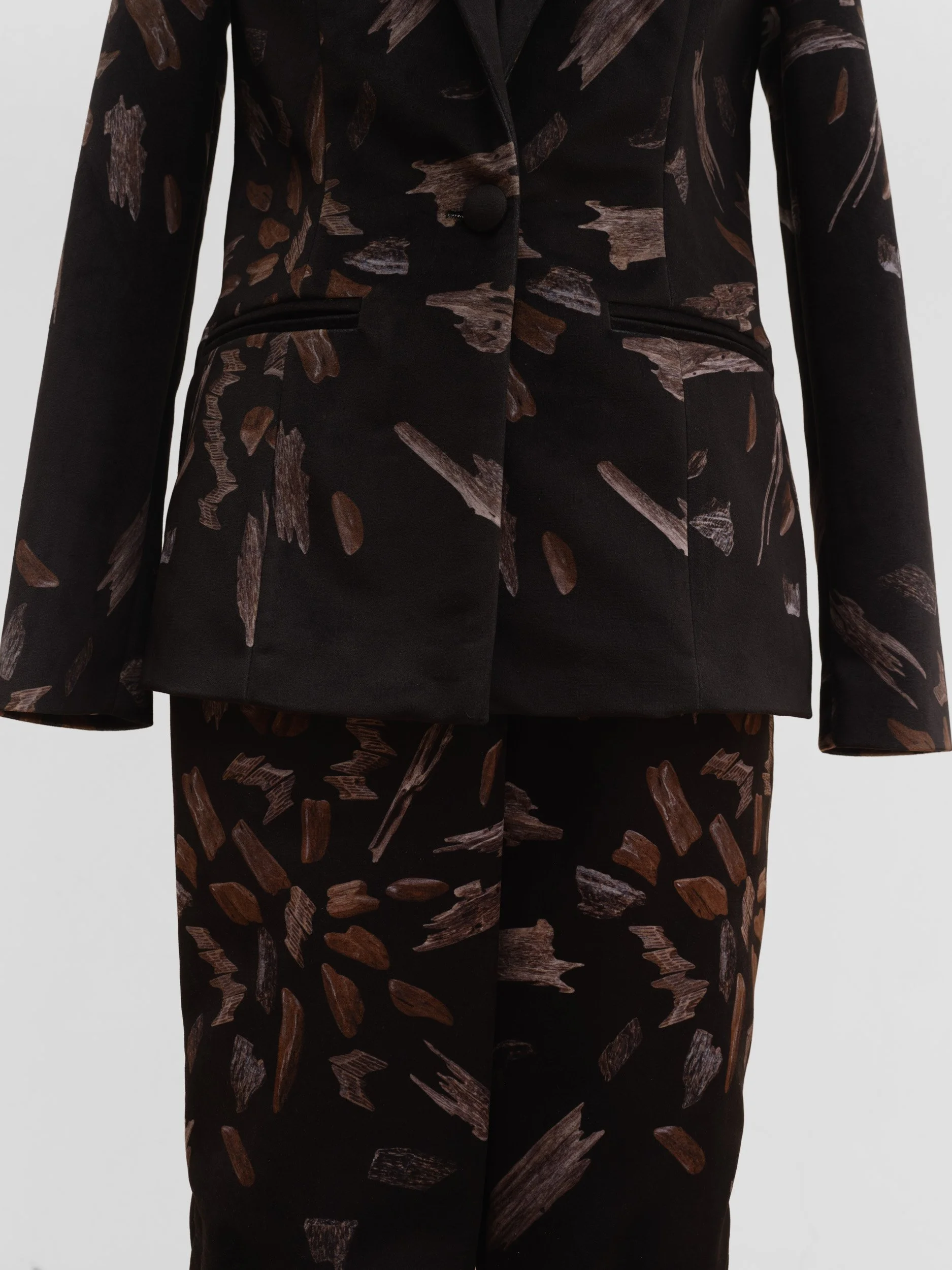
Across the exhibition, oud is approached with a forensic attention and displaced from scent into structure, embedded, burned, and circulated. The abaya expands beyond garment into system, carrying weight, absorbing impact, and resisting release.
All garments and sculptural elements were developed, manufactured, and crafted in Doha, in consultation and collaboration with local practitioners. Select components, including neon works, were produced in London with internationally recognised neon fabricators.
The approach to material is forensic not only in observation, but in search. Value is treated as something to be located, extracted, and examined within the object.
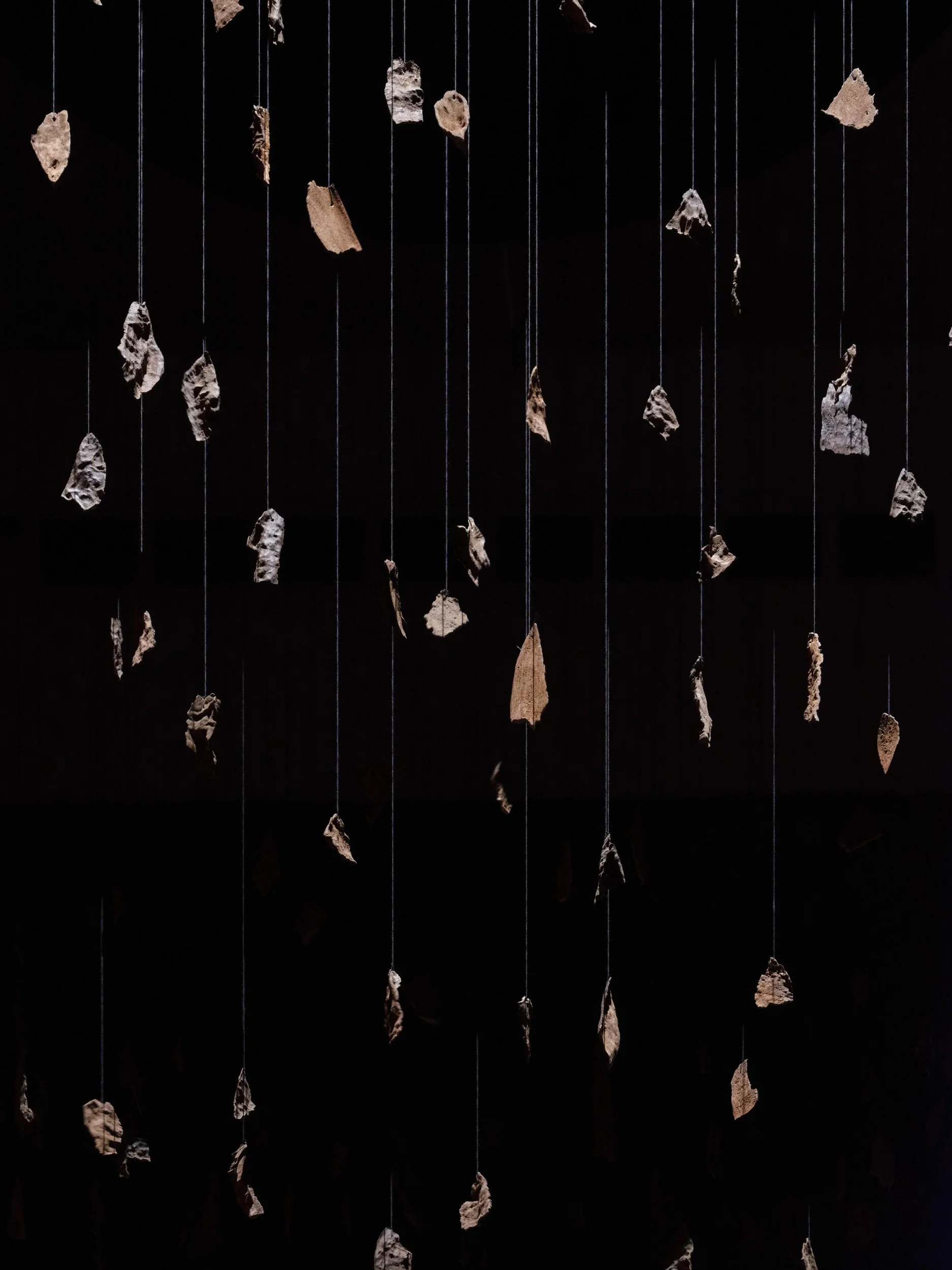
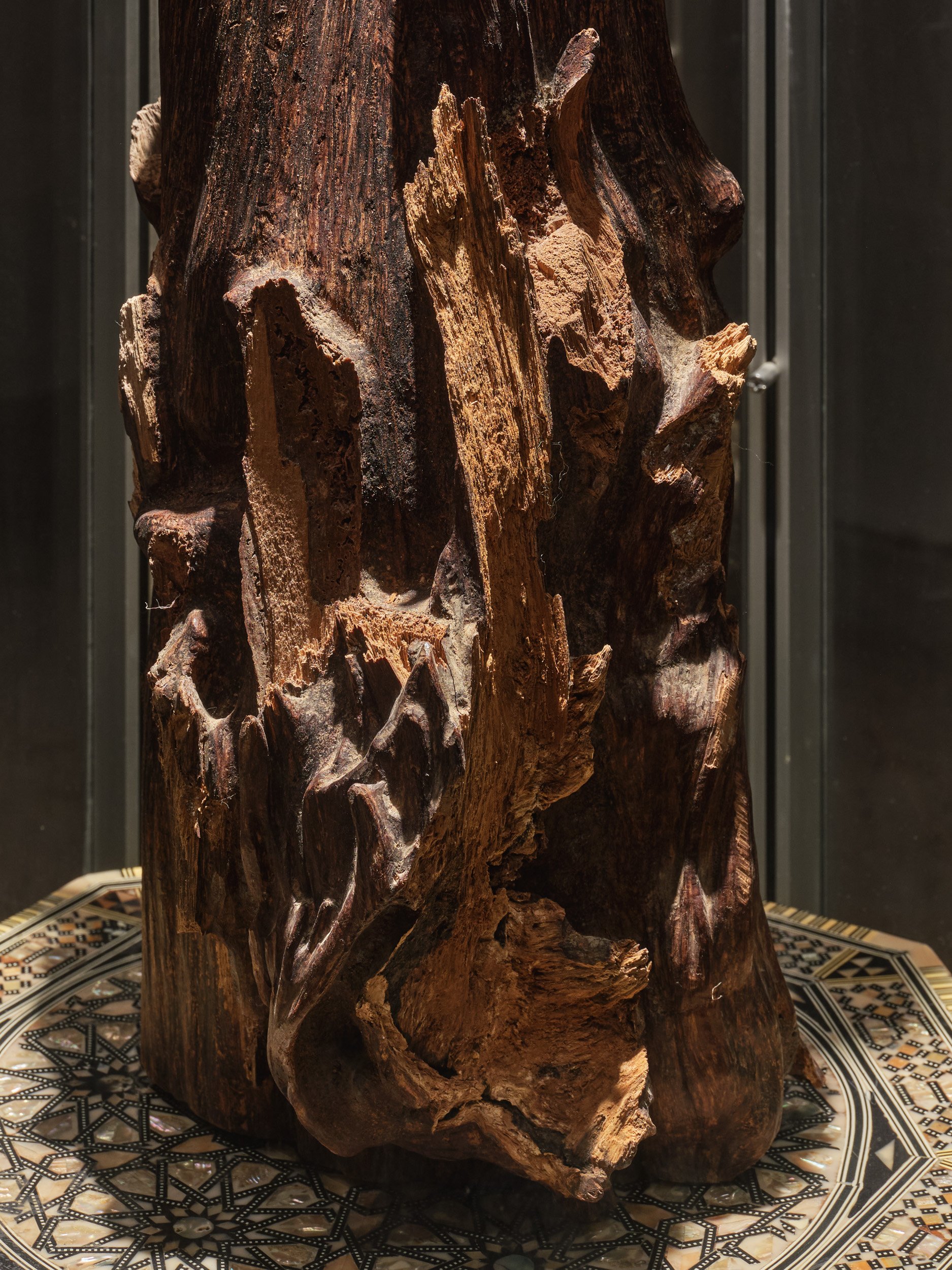
This is reflected in the trunk, where agarwood appears as stored matter, partially worked and partially intact. Variations in colour mark areas where the wood was previously chiselled for chips, though it remains largely unused. The trunk functions as an artefact, holding material that is now increasingly rare and endangered in this condition.
Private collectors have contributed to the contents of both the trunk and the cabinet, with two items contributed by the artist positioned alongside others of varying value. Differences in material worth and rarity are therefore observed rather than declared.
The pawn cabinet introduces a parallel condition in which objects are positioned within a system of appraisal. Value is assigned, held, and deferred rather than resolved. It contains older pieces of oud, oyster shells with small pearls deemed too unworthy to extract, and rare currency.
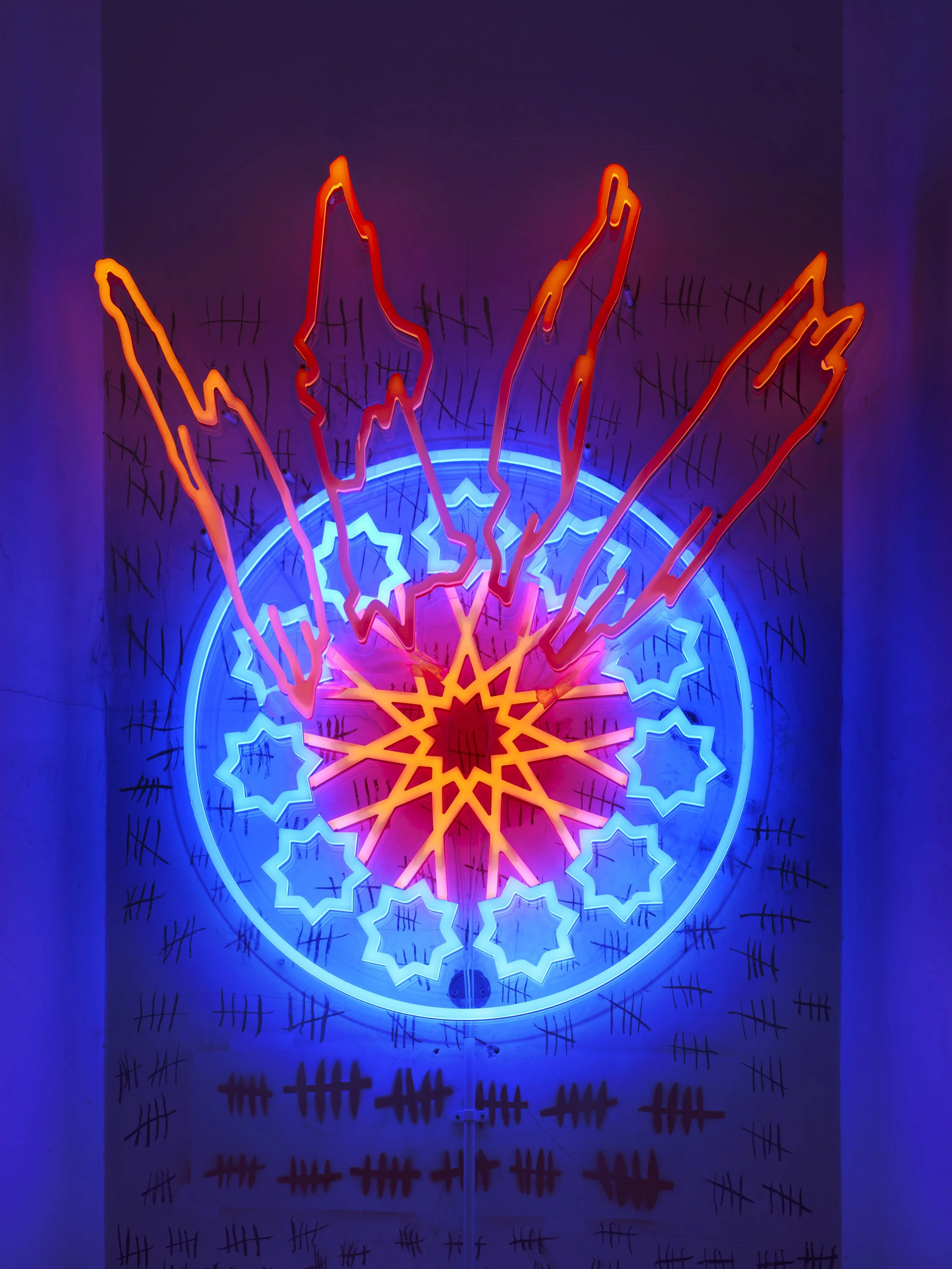
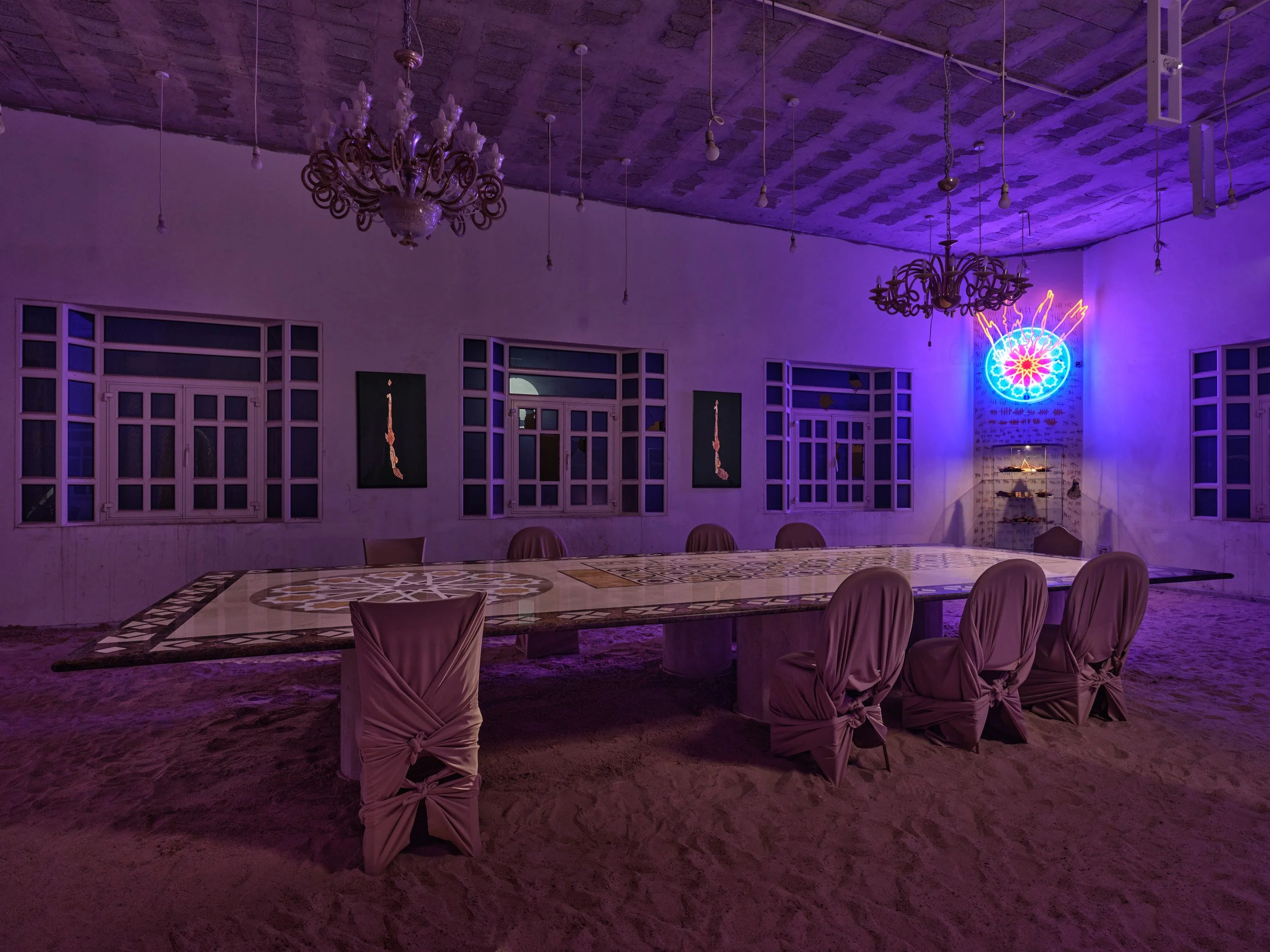
Elsewhere, material shifts into circulation and image. The Oud Casino establishes a system of movement without completion, while photographic works such as the oud gun and oil refinery prints extend the material into representations of industry.
The oud oil fountain introduces a state of flow, where material appears in excess and circulates beyond containment.
Together, these elements operate between artefact, system, and image. Value is neither fully preserved nor fully exchanged, but remains suspended.
Spatial Sequence
The exhibition unfolds from a central atrium, around which the spatial logic of the house is organised.
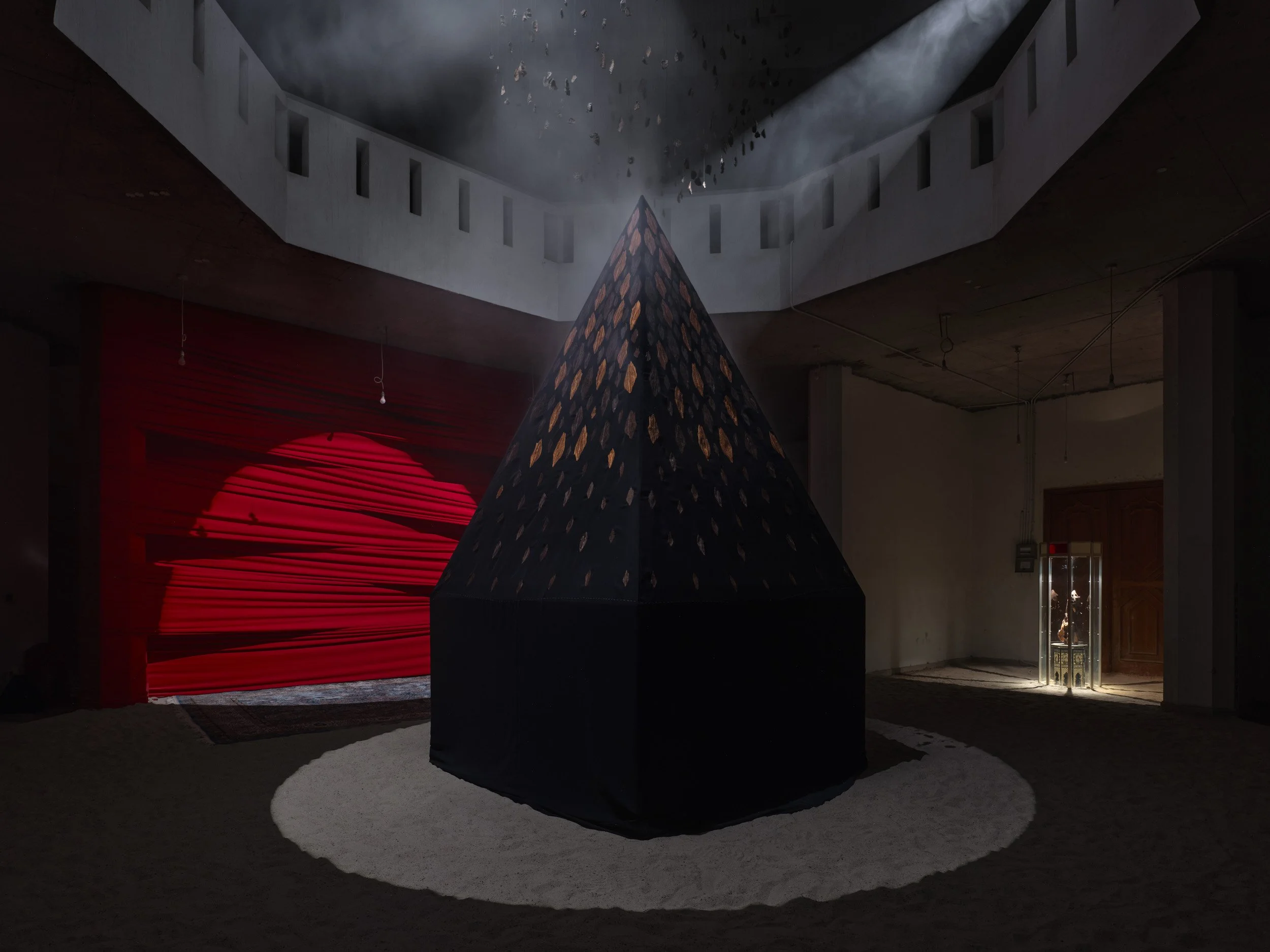
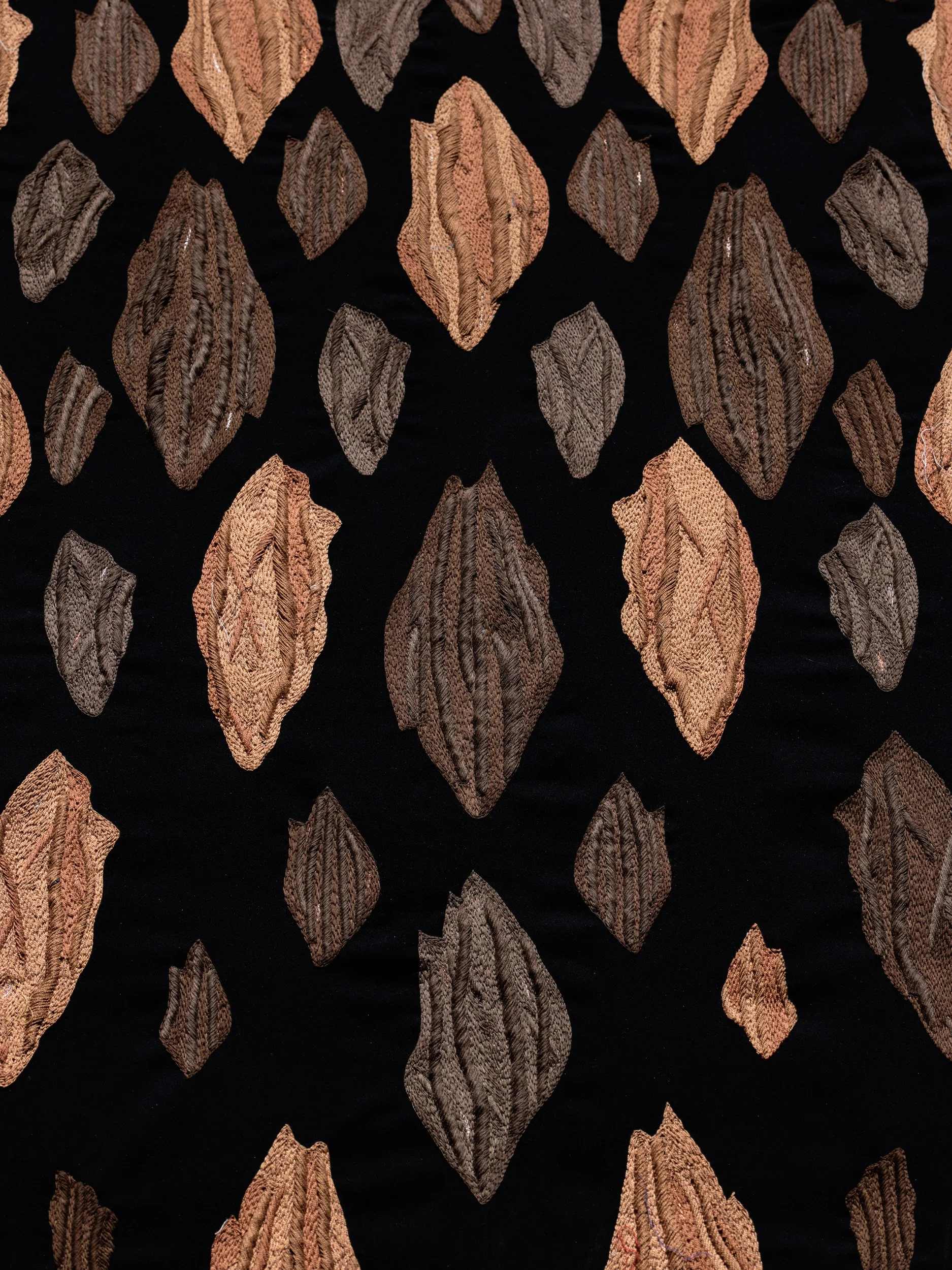
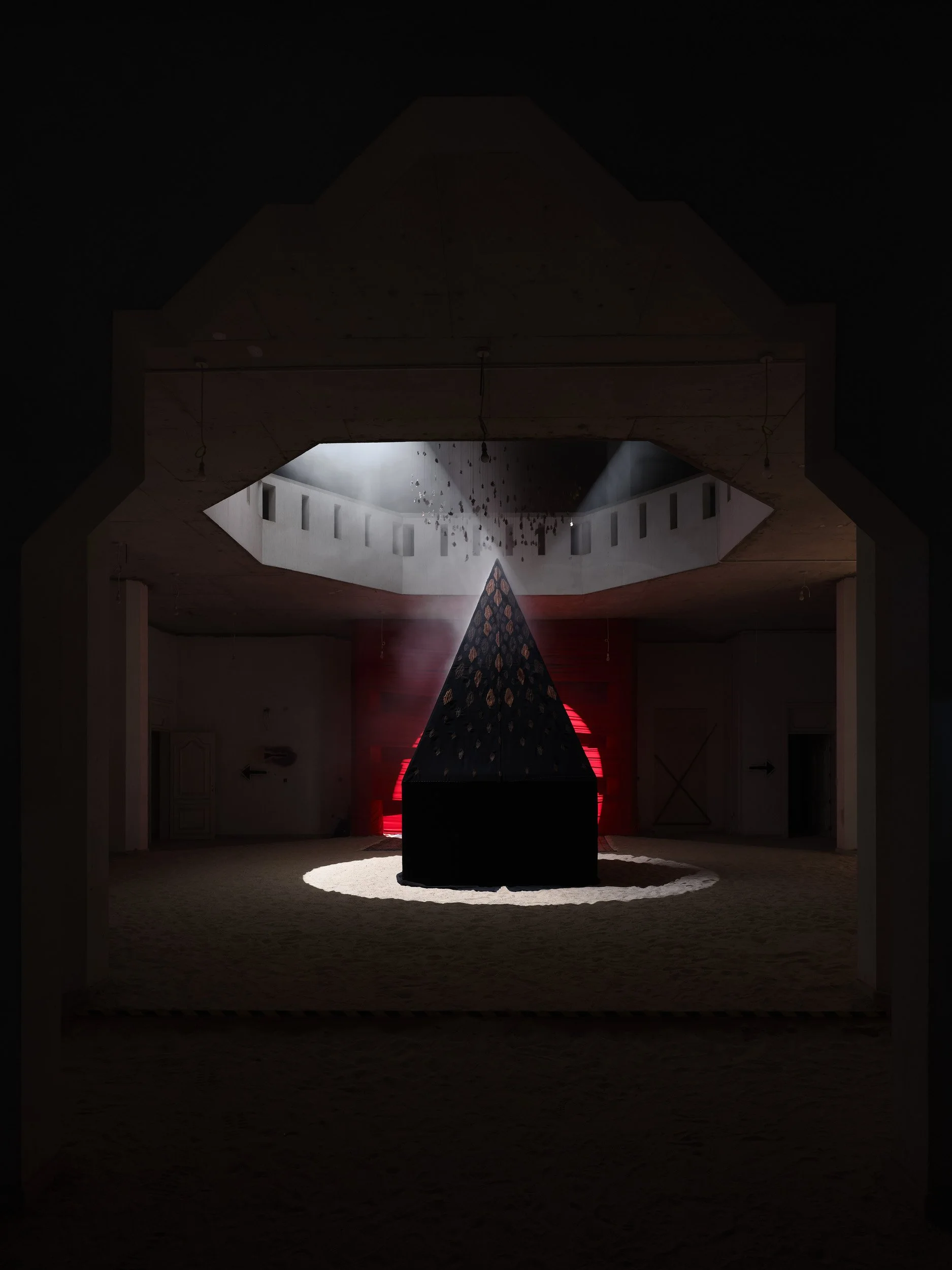
Atrium (Entrance and Incense Burner) Visitors enter directly into the atrium, an open hexagonal space at the centre of the house. At its centre sits the incense burner, activated throughout the evenings. Fitted with abaya fabric that functions as a smoke membrane, it releases smoke vertically into the space, establishing an immediate atmospheric condition upon entry. The embroidered pattern of agarwood chips across the fabric reads as a downward movement, resembling rain as it falls across the surface. Above, a moon is positioned within the upper opening of the atrium, aligning the work along a vertical axis from ground to sky. To the right of the burner, the oud trunk is positioned. To the left, the oud oil fountain appears as a corresponding form.
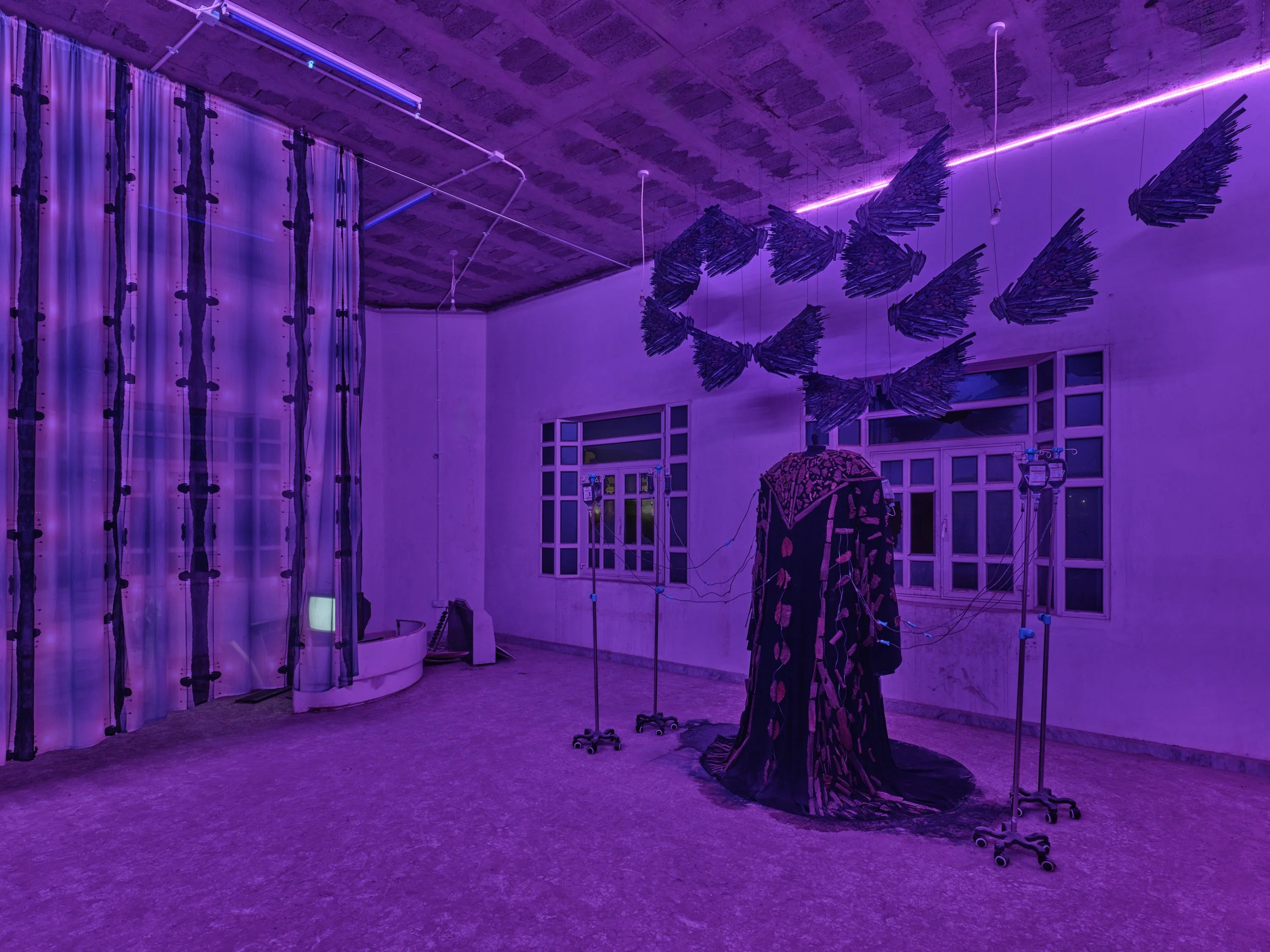
Right Room: IV Hospital A hospital-like environment in which the Oud Abaya is positioned within a state of care. The space is not entered and is observed from the outside. The Oud Abaya is cared for by a nurse, reinforcing a condition of maintenance and suspended recovery. This marks a second stage in the life of the work. Following its public appearance at 5/6 Park in Doha, the Oud Abaya moves from an open public setting into a contained domestic environment where care is administered in isolation. Curtains surrounding the installation carry a printed image of the IV island.
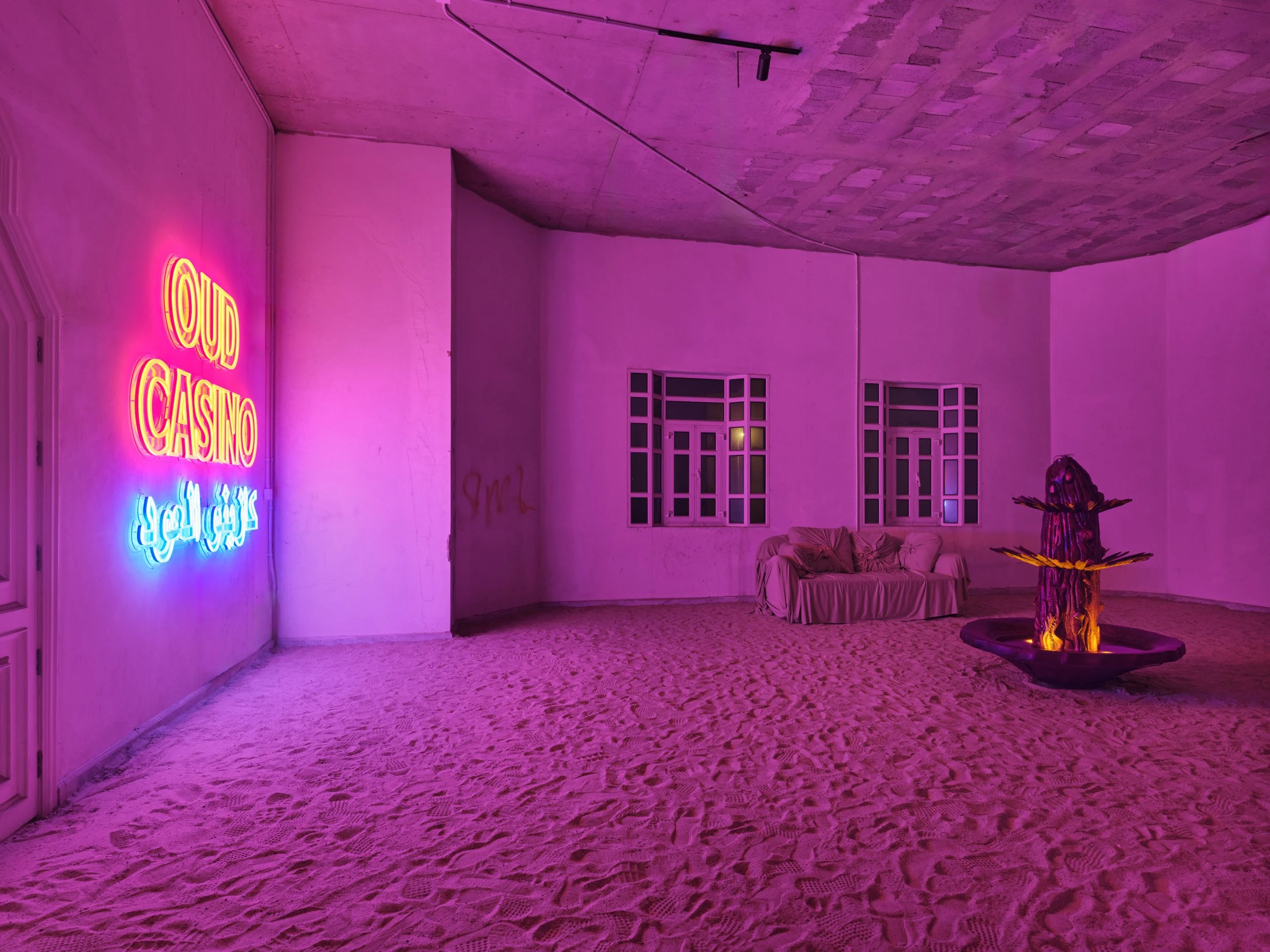
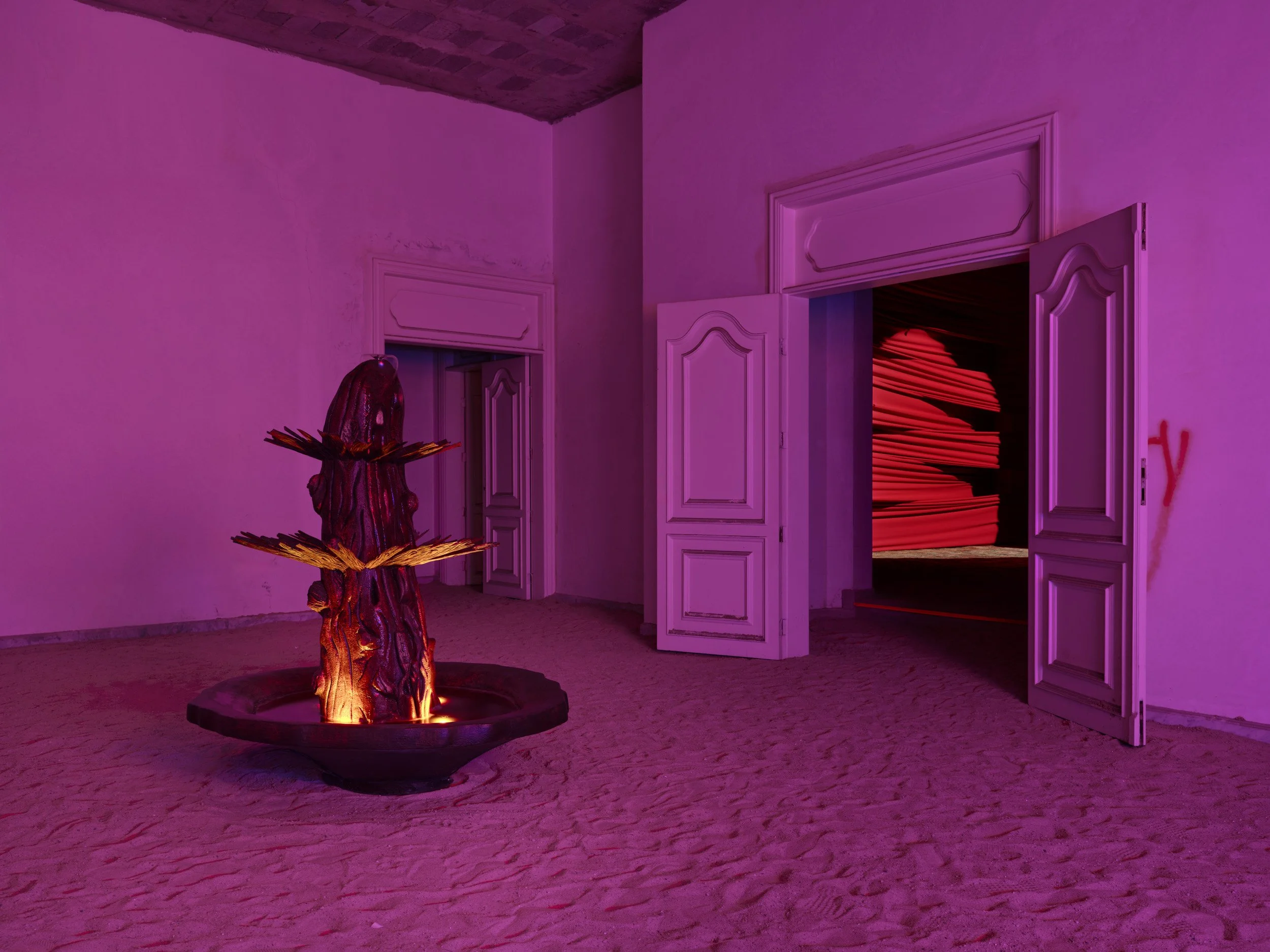
Threshold Room (Communal Transition) To the left of the atrium, a large threshold space mediates entry into the casino. A sofa introduces a communal condition, distinct from the seating within the casino. A fountain circulates oud oil, producing a continuous sound that recalls the historical use of water features as acoustic devices. The sound operates as a veil, partially masking the casino while creating a space for pause and contemplation.
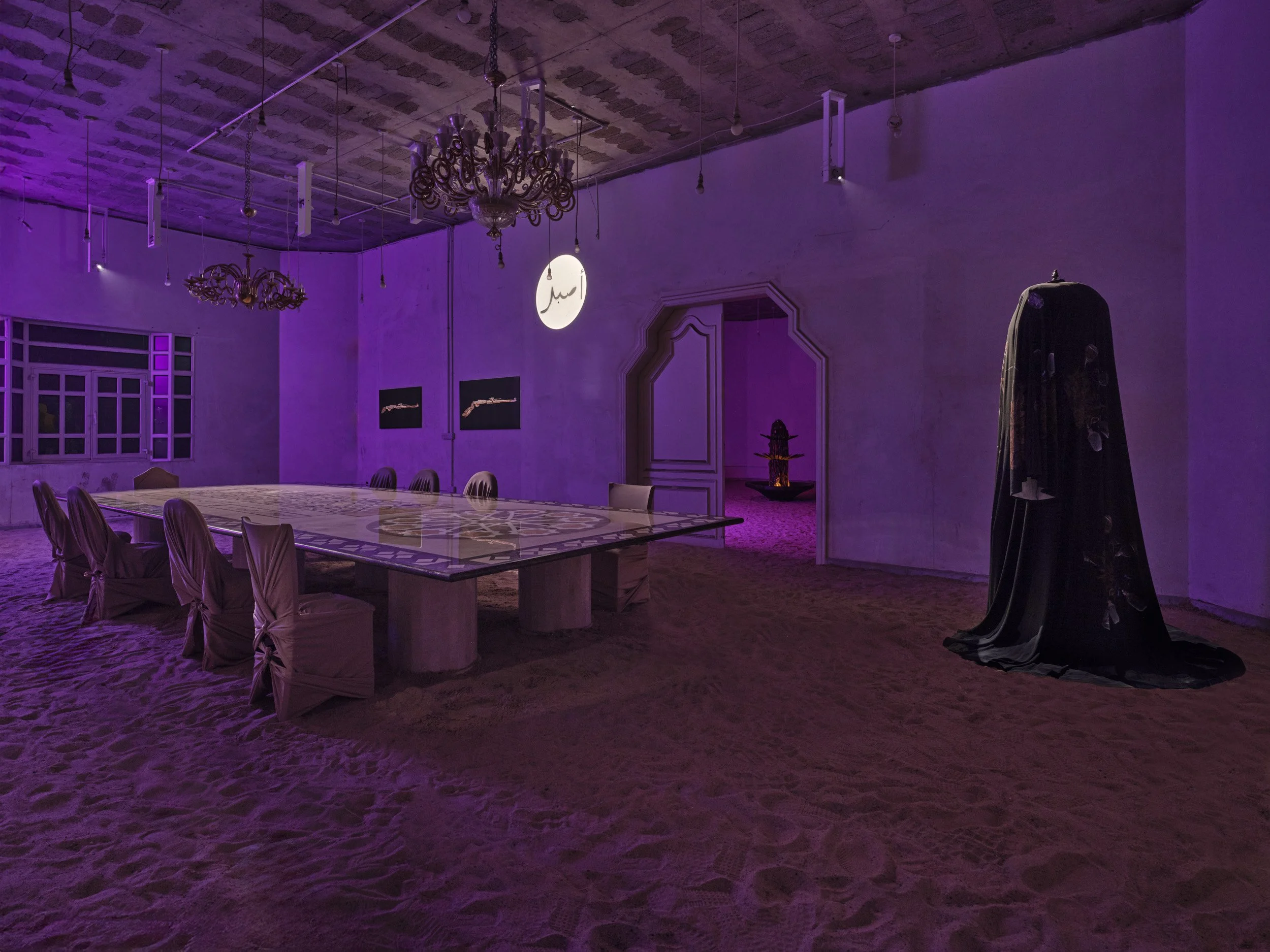
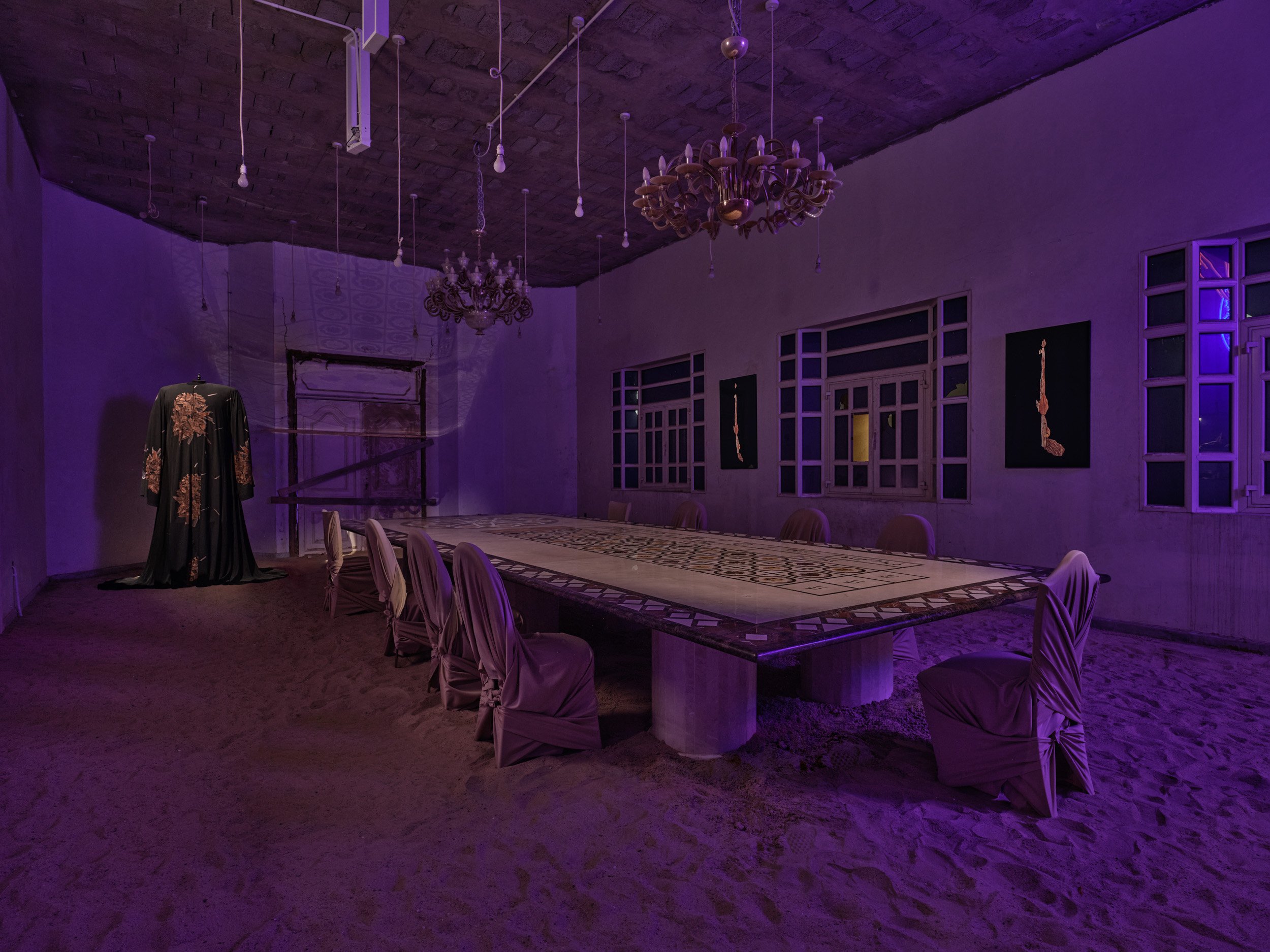
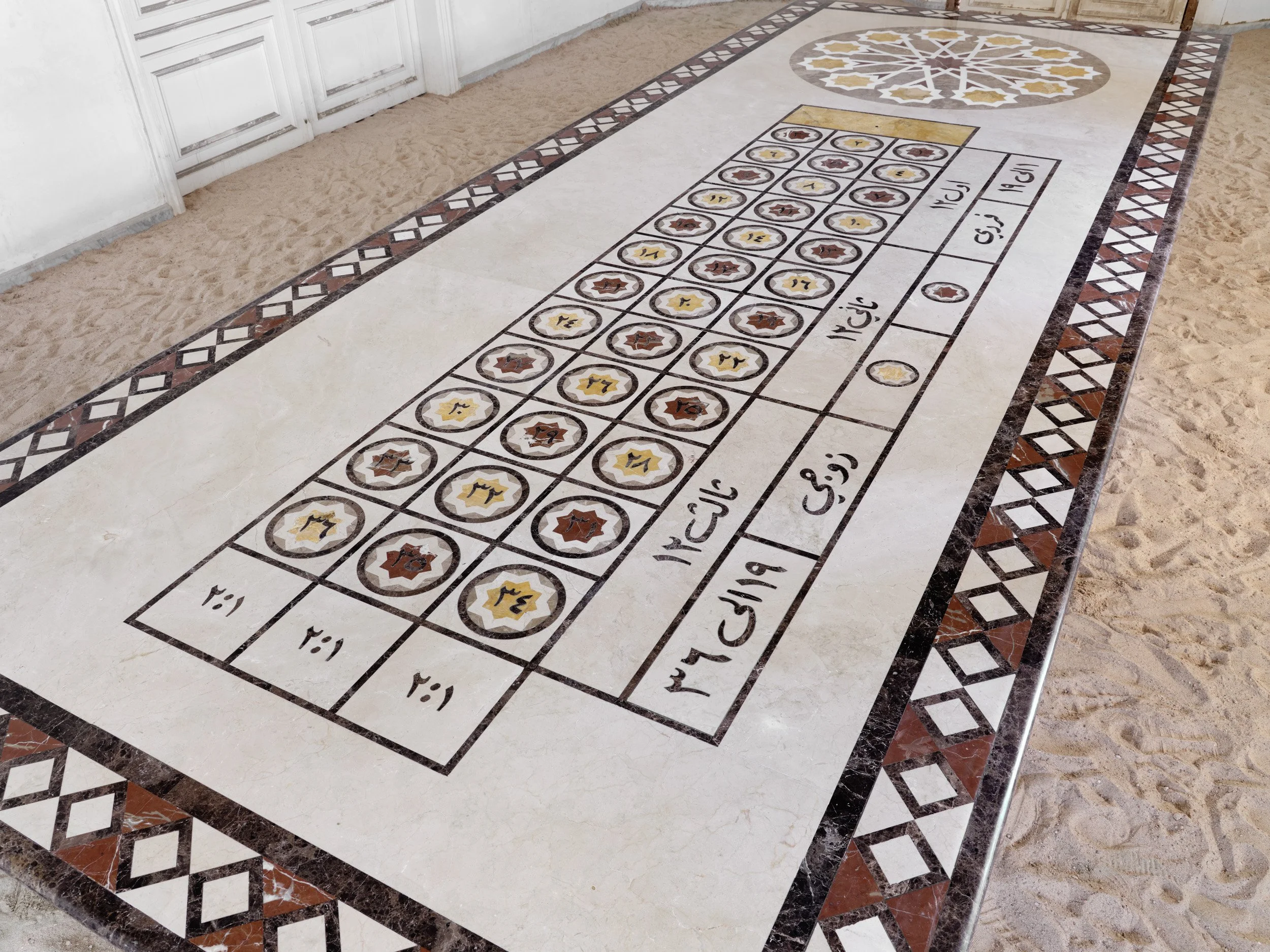
Casino Room A zone structured around the Oud Casino, where value is staged through a system that cannot be played.
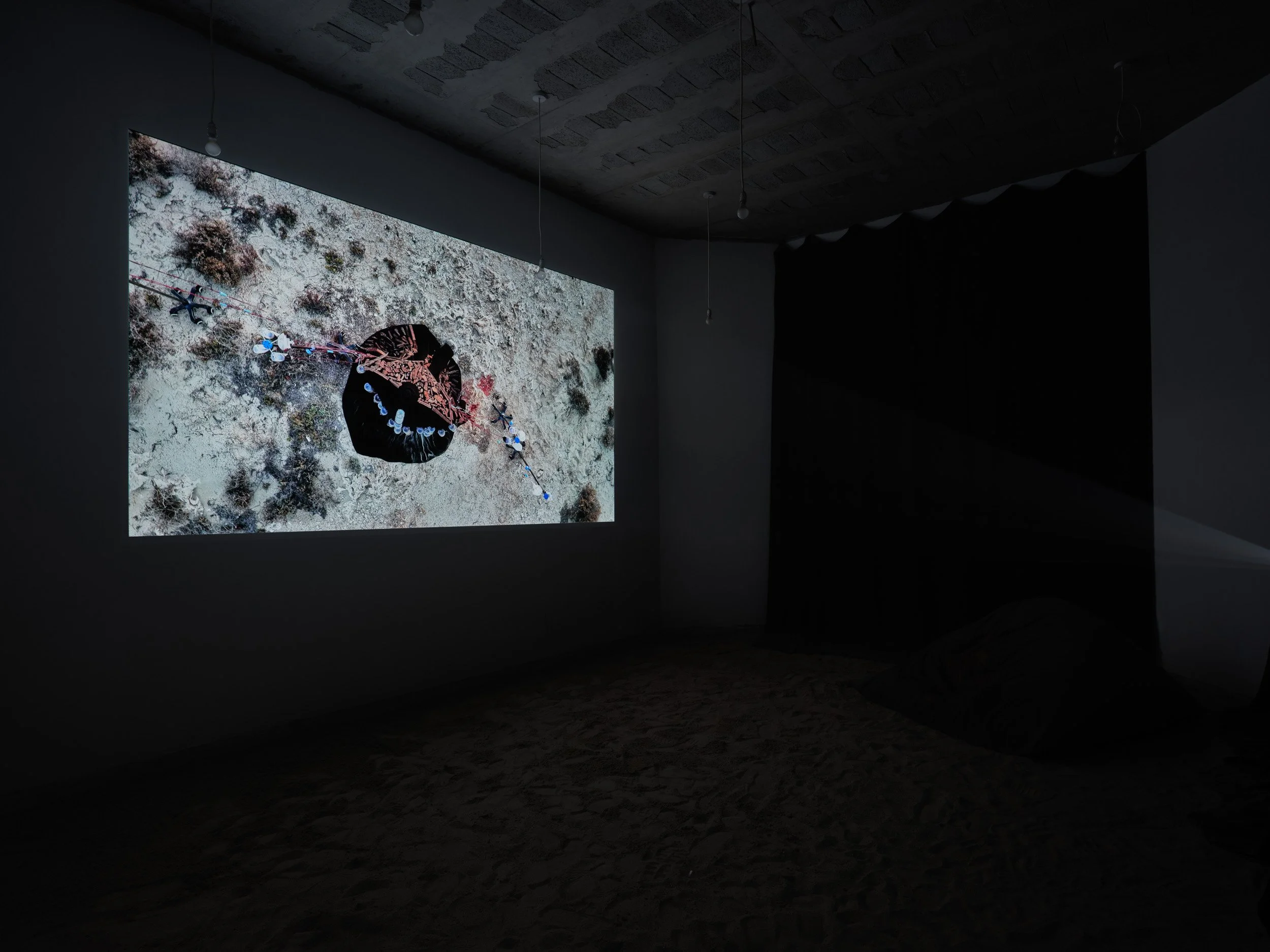
Rear Rooms IV Projection Room A separate room presents the IV island as projection.
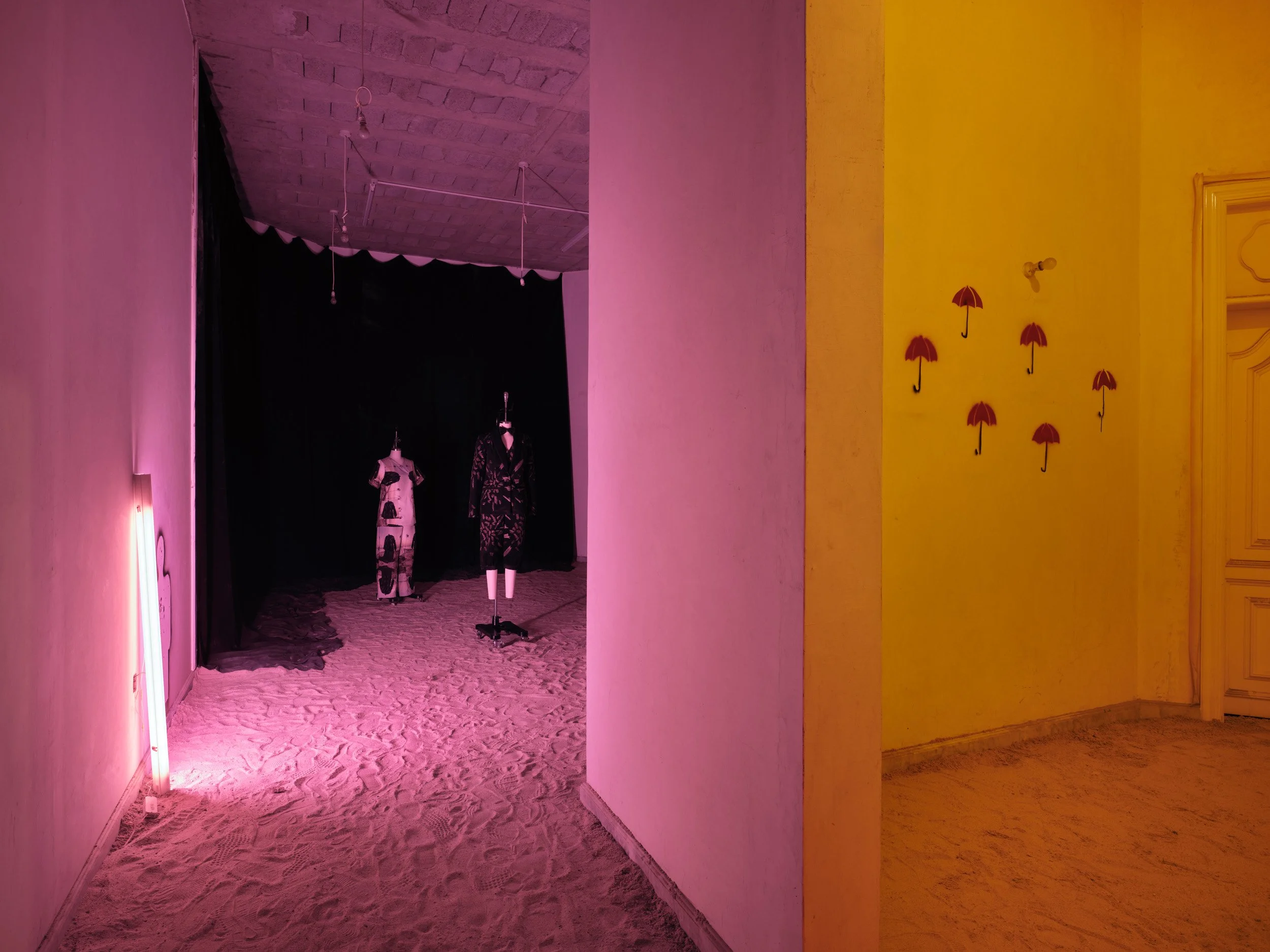
Uniform Room and Stairwell A room where uniforms are held and assumed, functioning as a preparatory space. Red umbrellas are present as elements of protection, associated with feminine forms of safeguarding and boundary.
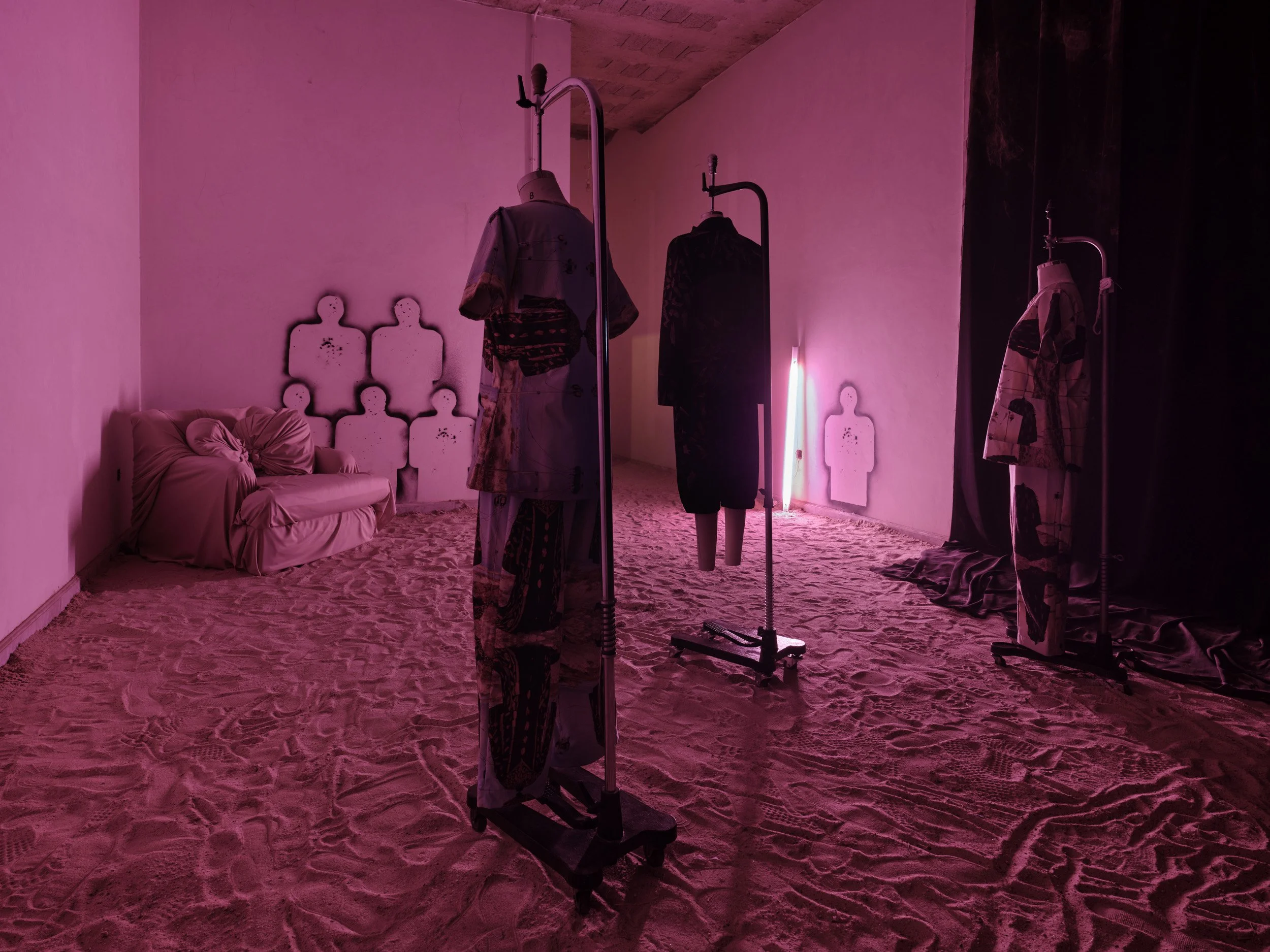
Dark Corridor A darker space accessed using a flashlight, positioned to the left of the incense burner and leading toward the roof, operating as a transitional zone.
Works within ASBAR
The exhibition is composed of installations, sculptural objects, and live routines that operate together within a single system.
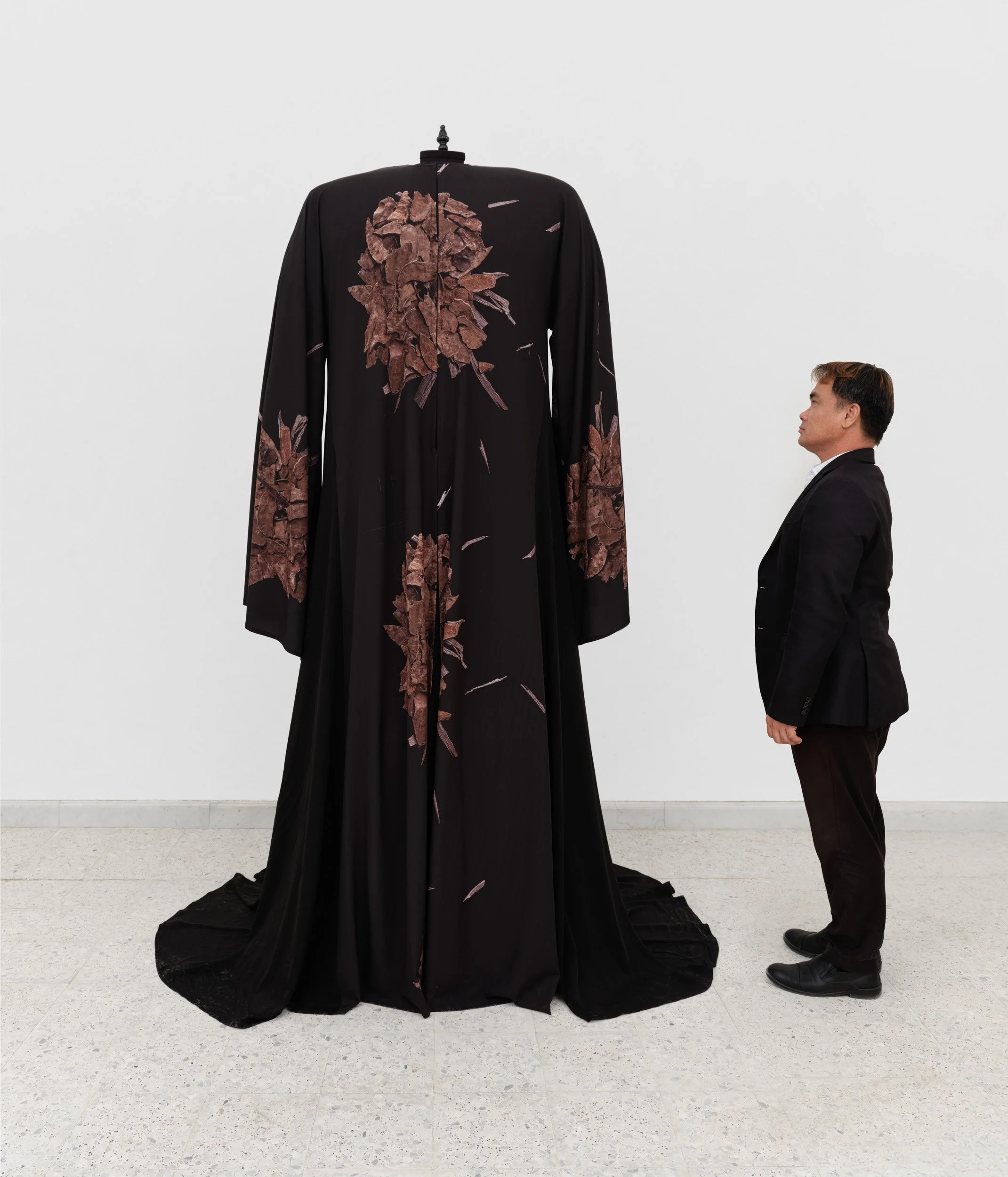
Blast Abaya A monumental abaya positioned as a central body within the Oud Casino space.
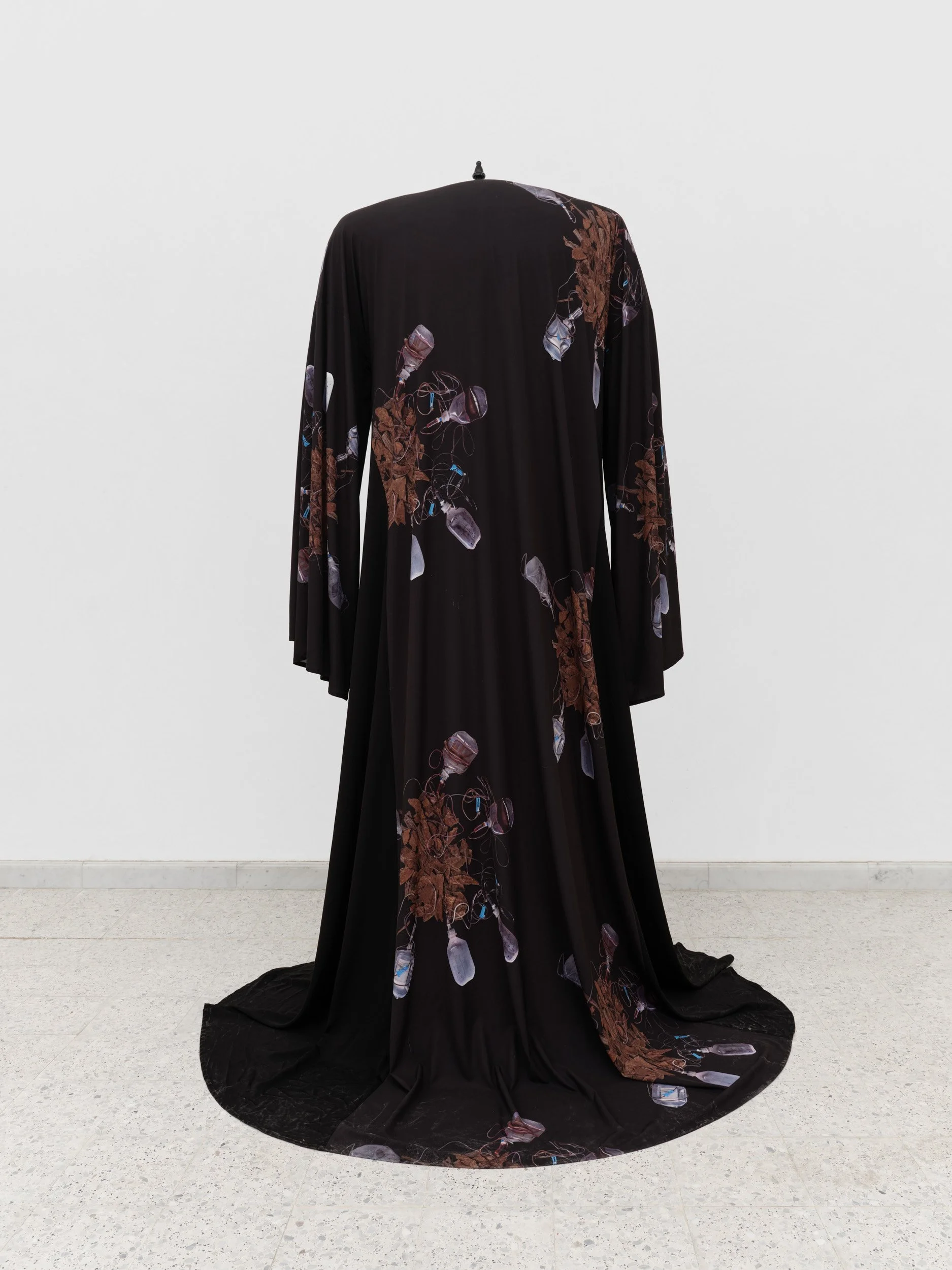
A monumental abaya (Back)
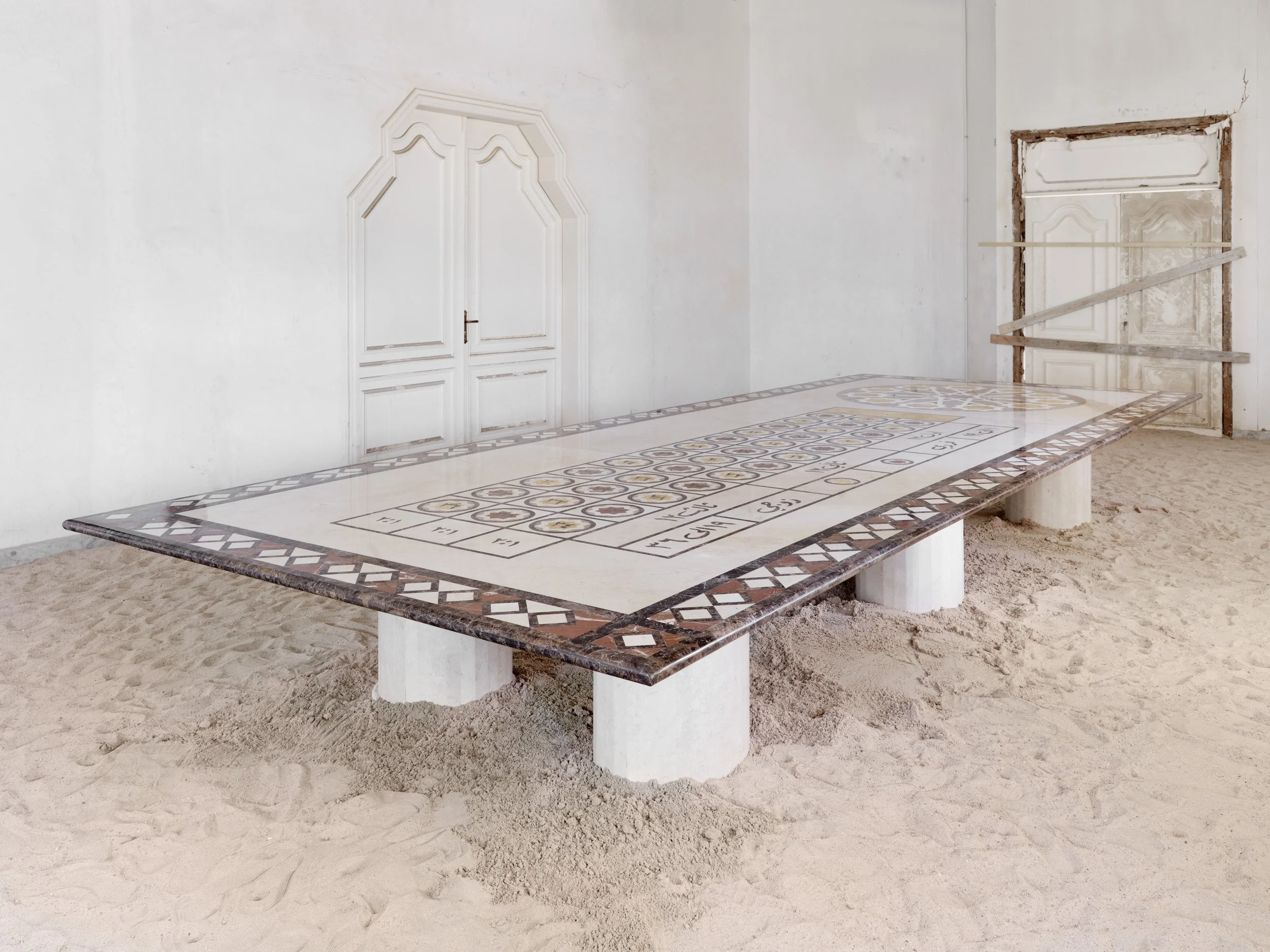
Arabic Roulette Table. The same number sequence and table divisions are preserved. The numbers are rendered in Arabic script, and the layout reconstructed within an Arabic spatial framework. The wheel is replaced by a central geometric motif. The casino logic remains intact. Intentionally unplayable. Marble.
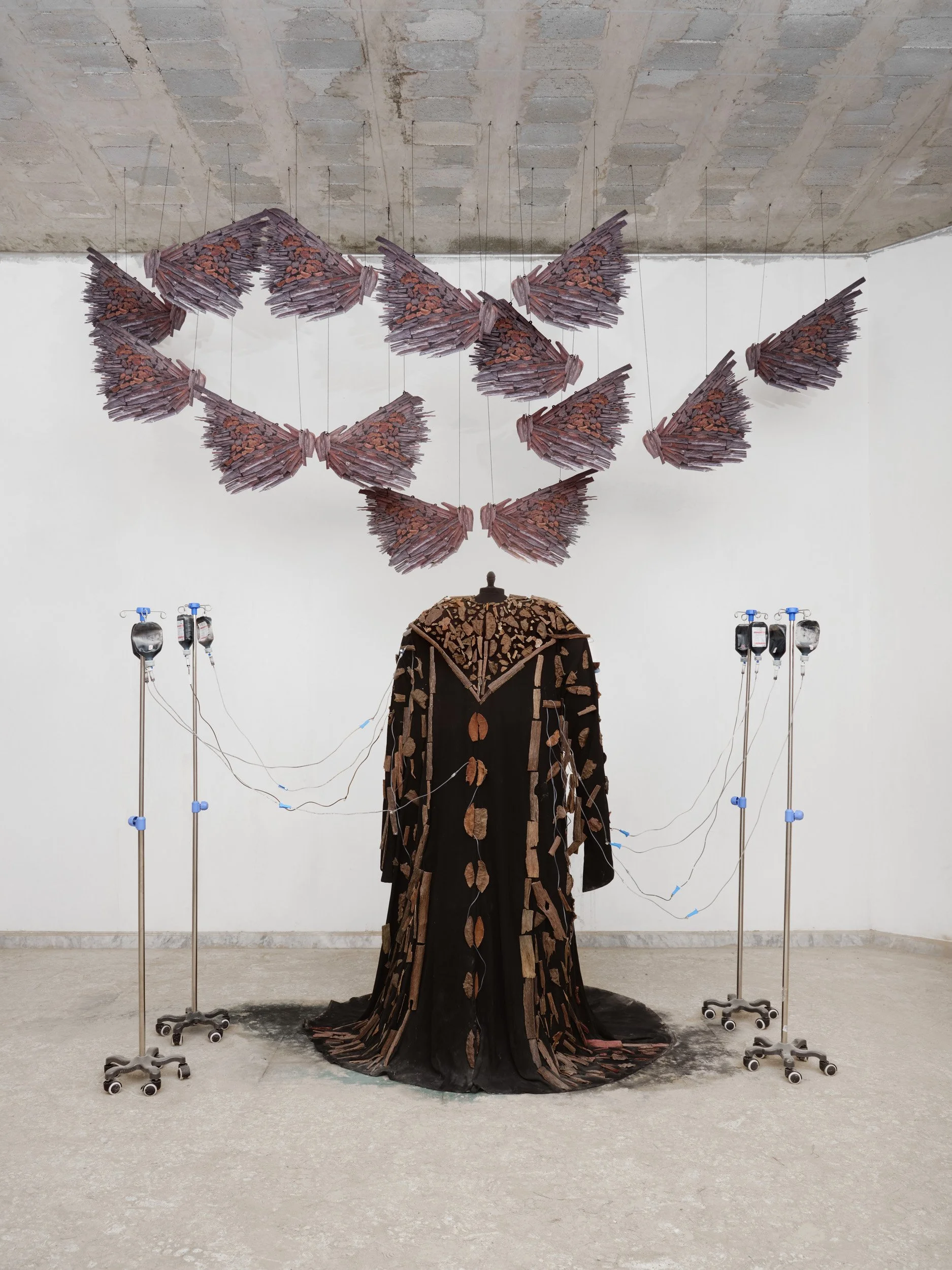
The Oud Abaya held within a condition of care, observed rather than entered and sustained through routine.
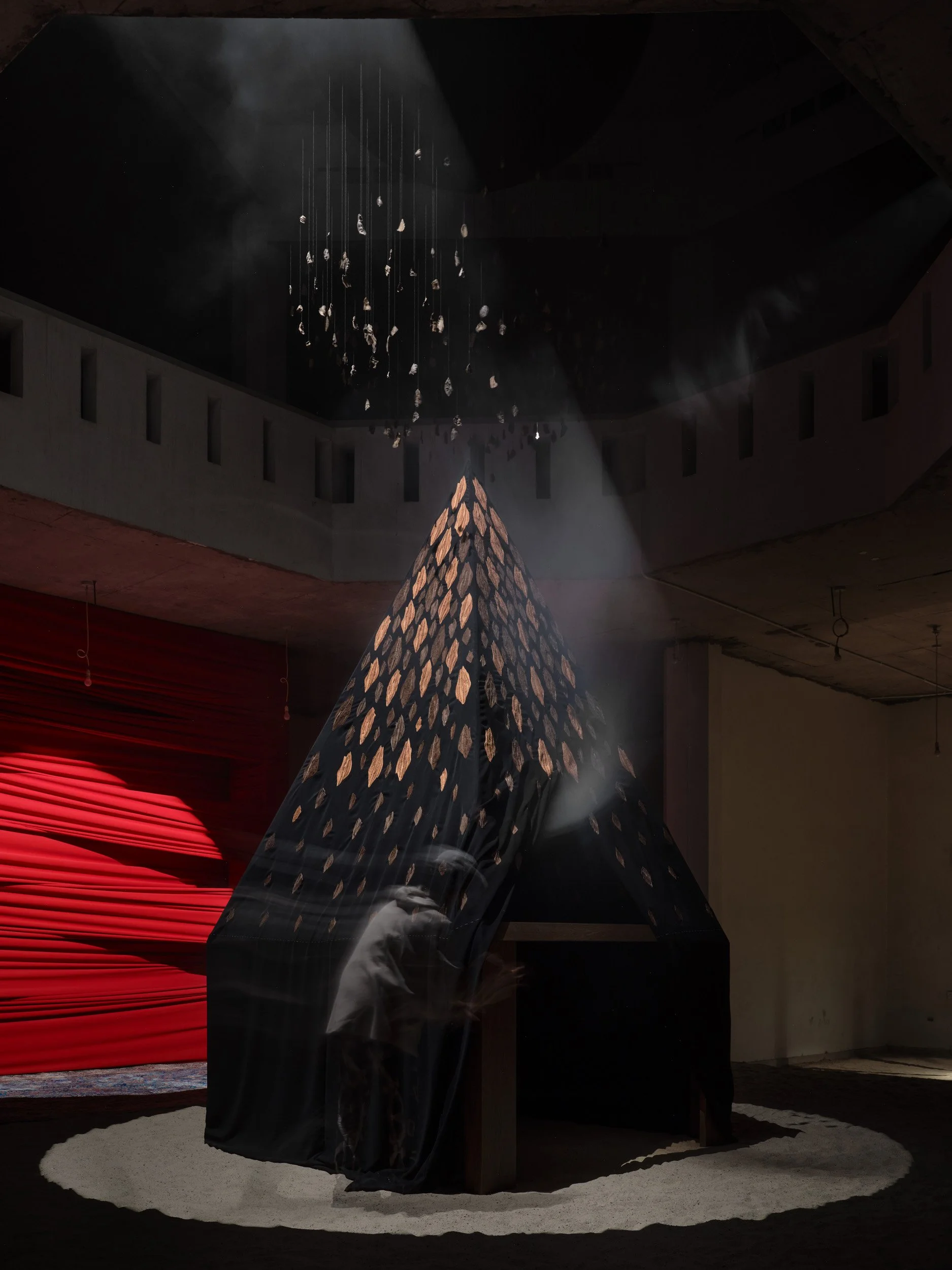
An incense burner structure fitted with abaya fabric draped across its surface, forming a membrane through which smoke is filtered and released. Positioned at the main entrance within the atrium, the work activates the central volume of the house, where smoke disperses through the space upon arrival. The structure also holds the capacity to function as a tent when not in use for burning. Within the exhibition, this function remains inactive and the form is kept closed. In an outdoor context, it can be activated as a tent.
Routines
Alongside the installations, a series of live routines activated the space daily across the exhibition’s five-day opening, sustained continuously throughout each evening.
Croupier Routine
A figure positioned within the casino, maintaining the presence of a system that cannot be played.
Nurse Routine
A figure attending to the abaya within the IV installation, caring for it as a body held in suspension.
Incense Routine
A figure maintaining the burner, periodically replenishing charcoal and sustaining the presence of smoke throughout the evenings. Charcoal was replenished at intervals, sustaining the production of smoke and marking the transition between material presence and atmospheric trace.
The house does not preserve what was. It continues to produce what remains.